
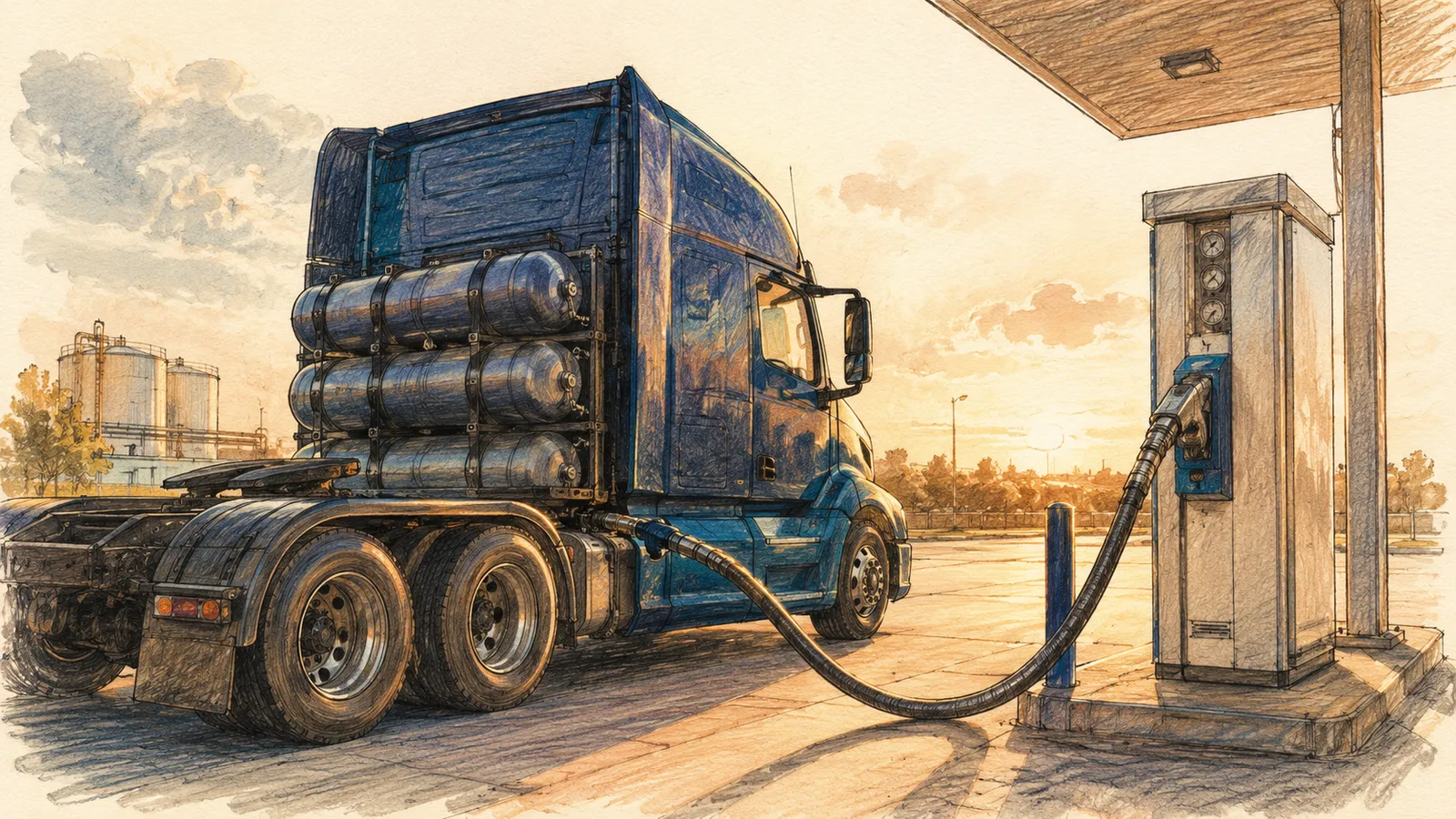
Liquefied natural gas, or LNG, is natural gas chilled until it turns into a liquid. Cooling it shrinks it enough to store and ship large amounts in bulk.
Natural gas takes up a huge amount of space as a gas. Chill it to about minus 260 degrees Fahrenheit and it condenses into a liquid that takes up a tiny fraction of that space. That liquid is LNG, and the shrinking is what makes it possible to move and store gas in bulk.
Because it has to stay so cold, LNG lives in heavily insulated tanks and trucks. As it slowly warms it turns back to gas, ready to burn. It fuels heavy long-haul trucks, ships, and customers in places a natural gas pipeline does not reach.
LNG and CNG are two ways to carry the same gas. CNG squeezes it under pressure and suits fleets that refuel close to home. LNG chills it to a liquid and suits heavy users and long distances, because a liquid tank holds far more fuel for its size.
For a fuel marketer, LNG is a specialized product. The cold-chain handling and the tanks are demanding, so it tends to serve large, steady accounts rather than the everyday retail customer.
In useA long-haul carrier fuels its heavy trucks on LNG so each tank holds enough chilled liquid gas for the long runs between cities.
Where the word comes from
The name describes the process: natural gas that has been liquefied, turned from a gas into a liquid, by chilling it.
See also Compressed natural gas (CNG), Renewable natural gas (RNG)