
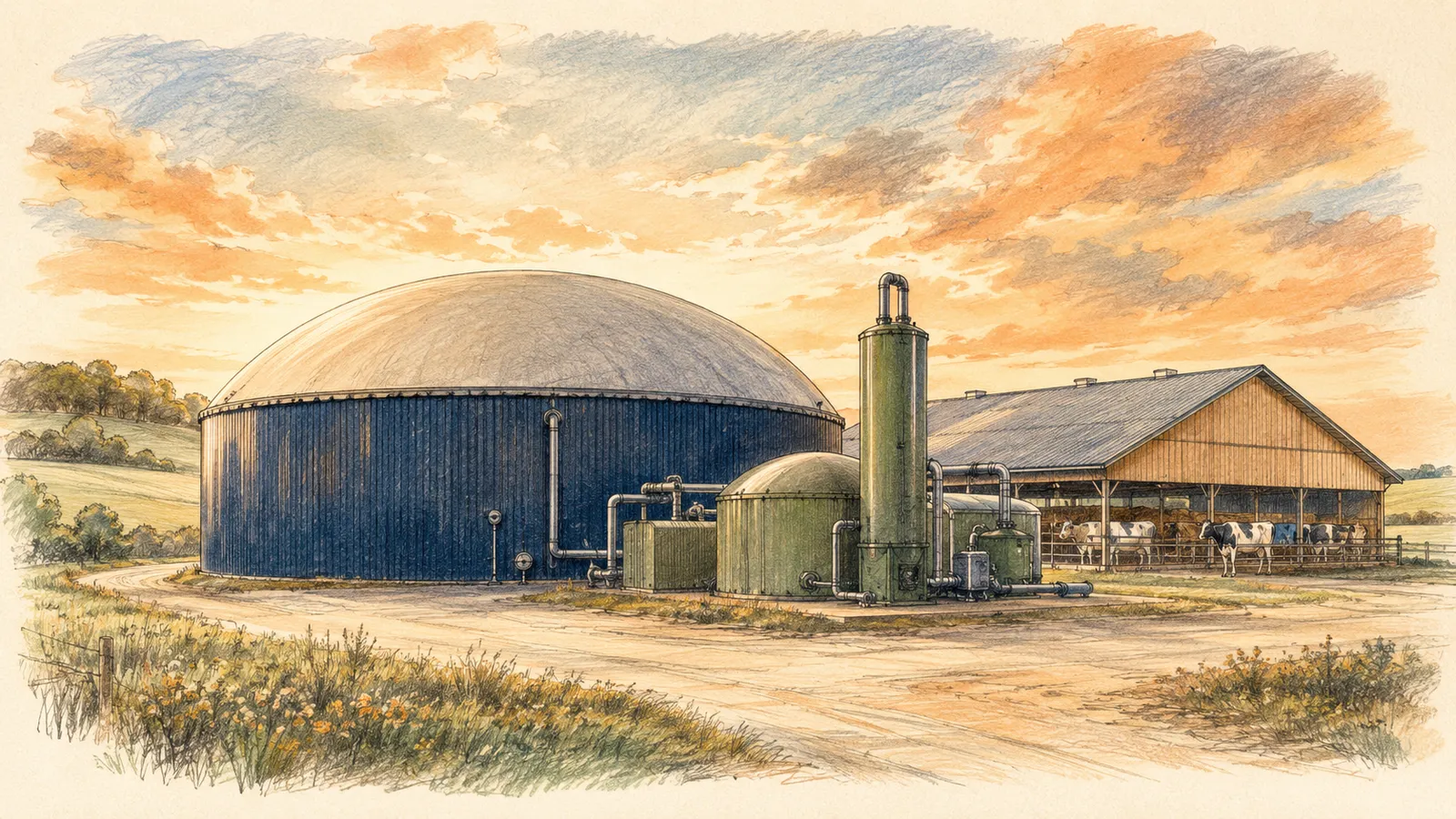
Biogas is the raw, dirty gas given off as organic matter rots without air, in a landfill, a manure digester, or a wastewater plant. It is mostly methane mixed with carbon dioxide and other contaminants.
Whenever organic material breaks down without oxygen, it releases gas. That gas is biogas. It is roughly half methane, the part that burns and the part that makes natural gas useful, and half carbon dioxide and other junk that does nothing for a fuel and can foul equipment.
In its raw state biogas has limited use. It can be burned right on site to make heat or run a generator, but it is too dirty and too weak to put in a pipeline or a vehicle tank as it is.
Its real value comes after cleanup. Strip out the carbon dioxide, water, and contaminants, and what is left is concentrated methane that matches ordinary natural gas. At that point it becomes renewable natural gas, ready for the pipeline and the same uses as drilled gas.
So biogas is the starting material and renewable natural gas is the finished product. Knowing the difference matters in the fuel trade, because the credits and the value attach to the cleaned-up gas, not the raw stream.
In useThe wastewater plant flares its raw biogas for years, then installs a cleanup unit so the same gas can be sold as pipeline-ready renewable natural gas.
Where the word comes from
Biogas joins bio, meaning made from living matter, with gas. It names the gas that living matter gives off as it decays.
See also Renewable natural gas (RNG), Compressed natural gas (CNG)