
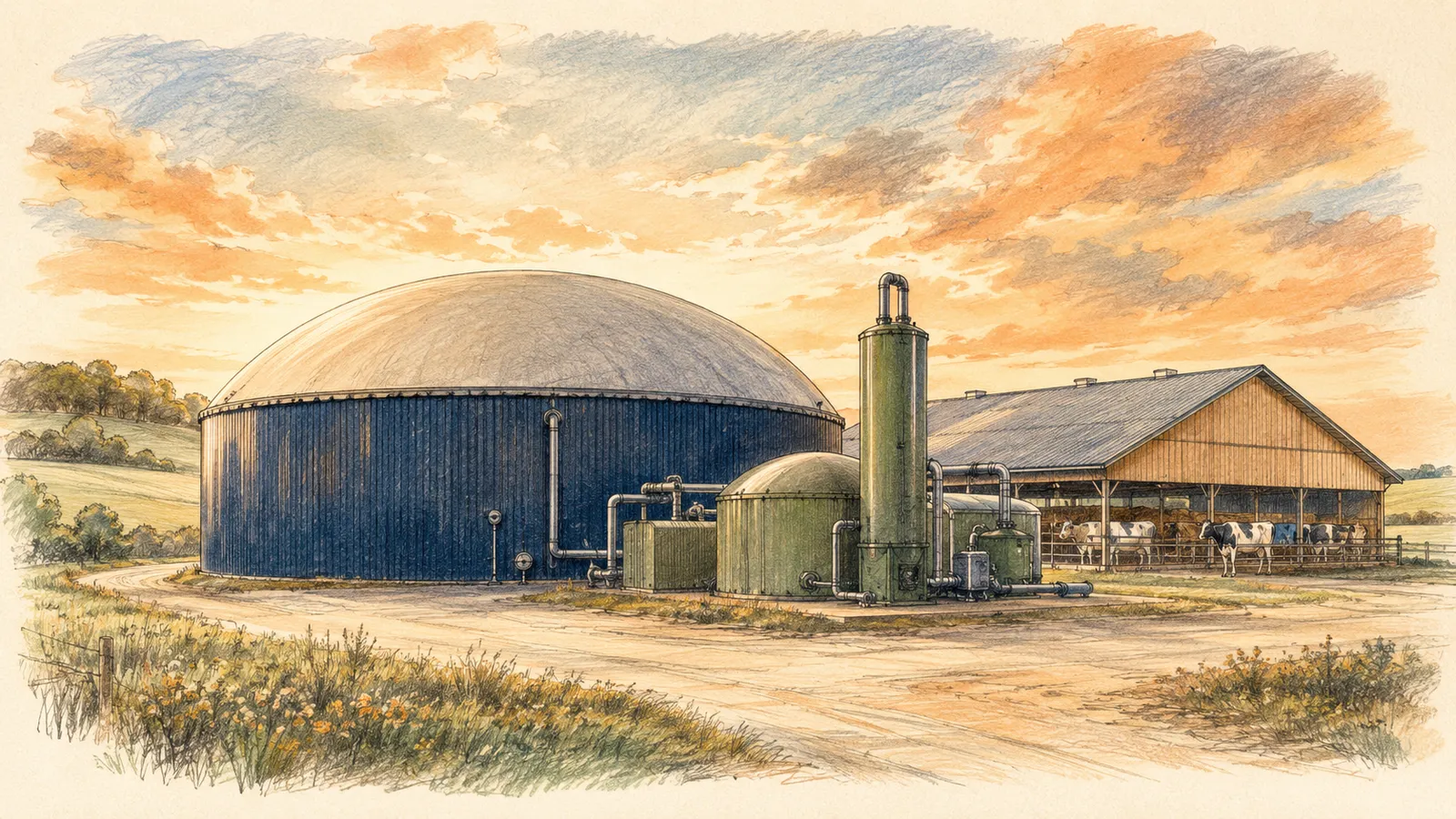
Renewable natural gas, usually shortened to RNG, is natural gas captured from rotting waste instead of drilled from the ground. The methane that cow manure, garbage, and sewage give off as they break down gets cleaned up until it matches the gas in a pipeline. Once it passes that spec it burns in the same engines, the same burners, and the same trucks as ordinary natural gas, and nobody at the nozzle can tell the difference. For a fuel marketer, the gas itself is the easy part. The money and the complication both live in the paperwork that proves where it came from.
Where the gas actually comes from
Whenever organic matter rots without air, it gives off methane, which is the main thing that makes natural gas useful. RNG starts by trapping that methane before it floats off. The biggest sources are dairy and hog farms, where manure sits in covered lagoons or sealed tanks called digesters; landfills, where buried garbage breaks down for decades; and wastewater treatment plants, where sludge does the same thing. The raw gas these sites give off is called biogas, and it is dirty. Roughly half of it is methane and the rest is carbon dioxide and other junk that fouls equipment. A cleanup unit strips out the carbon dioxide, water, and contaminants until what is left is concentrated methane that meets the pipeline standard. At that point it stops being biogas and becomes RNG. Chemically it is the same molecule as the gas pulled out of a Texas well, so it can ride the existing pipeline grid and feed any equipment that already runs on natural gas.
How it gets used as a motor fuel
Natural gas is very light, so at normal pressure a useful amount would never fit in a vehicle tank. There are two ways around that, and RNG works in both. The common one is compressed natural gas (CNG), where the gas is squeezed under high pressure until enough of it fits on board. CNG suits fleets that come home to the same yard every night and fuel up there: transit buses, refuse trucks, delivery vans, and local haulers. The other is liquefied natural gas, or LNG, where the gas is chilled until it turns to a liquid that takes up far less room. LNG suits heavy long-haul trucks and other big users that need a lot of fuel for the distance. The fuel in the tank is the same whether the molecule came from a well or a dairy. A fleet that runs on CNG can switch its supply to RNG and the trucks never notice. What changes is the carbon score and the credits that ride with it, which is usually the whole reason a fleet makes the switch.
Where the money is
RNG sells for more than the energy in it, sometimes a lot more, because it earns credits under two separate programs. The first is the federal Renewable Fuel Standard, and its RINs. A RIN is the credit that proves a gallon of renewable fuel was made and sold. RNG used as a transportation fuel generates RINs, and the type it earns is what makes it valuable. RNG from manure digesters, landfills, and wastewater plants qualifies as cellulosic biofuel, which means it earns D3 RINs. D3 is the most valuable RIN category, because the supply is tight and the law demands the steepest carbon cut to qualify. Some other RNG can fall into the D5 advanced category, which is worth less. Either way, the RINs attach when the gas is dispensed into a vehicle, and they are sold separately from the gas to the refiners and importers who are obligated to buy them.
The second pot of money is in LCFS states. California runs a program called the Low Carbon Fuel Standard, or LCFS, and Oregon and Washington run their own versions. These programs score every transportation fuel by its carbon intensity, meaning how much greenhouse gas it puts out across its whole life. Fuels that beat the yearly target earn credits. Fuels that miss it owe deficits and have to buy credits to cover the gap. Here is the part that makes manure RNG unusual. When a digester traps methane that would otherwise have leaked out of an open manure lagoon, the program counts that avoided leak in the fuel's favor. Under the program's carbon math, capturing that methane counts as a large benefit. That math can drop manure-derived RNG to a very low carbon intensity, and in many cases a negative one. A negative score means the fuel earns more LCFS credits per unit than a zero-carbon fuel would. That is why dairy RNG has drawn so much investment, and it is also why the negative scores are argued over, so treat the exact numbers as something that shifts with the rules.
Where a fuel marketer fits
You do not have to build a digester to be in this business. There are a few honest spots for a marketer along the chain. The most natural one is fueling: putting in CNG or LNG dispensing for fleet customers who want it, and sourcing RNG to fill those tanks. A transit agency, a hauler, or a city fleet signs up for a cleaner fuel, and you are the one who delivers the gas and runs the station. A second spot is sourcing and moving the product, lining up RNG supply from a producer or a marketing group and matching it to the fleets that want the credits. A third is helping a customer who already burns natural gas understand what switching to the renewable kind does to their fuel cost once the credit value is counted in. None of this is the same as your diesel and gasoline business. The customers are committed fleets rather than the walk-in public, the equipment is high-pressure or cold-storage gear rather than ordinary pumps, and the value sits partly in a credit rather than entirely in the gallon.
The contracts and how the credits get tracked
The credit value only shows up if you can prove the chain from the waste to the wheel. Because RNG is the same molecule as fossil gas, the two mix freely once they hit a pipeline, so the renewable claim rides on contracts and tracking rather than on the physical gas. The producer injects RNG at one end of the pipeline, your station pulls regular pipeline gas out the other end, and a contract assigns the renewable attribute to the gas you dispensed. People call this book-and-claim. It means your supply agreement has to spell out who owns the environmental attributes, the RINs and the LCFS credits, on every unit. Get that wrong and you can deliver the gas and lose the value that made the deal worth doing. So the contracts matter as much as the fuel, and the records behind them have to be airtight.
The record-keeping reality
This is where the day-to-day work lives, and it is heavier than a diesel drop. Every unit of RNG you dispense as a motor fuel has a RIN tied to it, and that RIN has to be tracked, reported in the EPA's system, and either sold or passed along with clean documentation. Every LCFS state wants its own quarterly reporting, with the carbon intensity score and the volumes broken out by fuel and by pathway. You log the gas you took in, the gas you dispensed, which fleet got it, and the credit that attached to each unit. Miss a report or muddle a volume and you can lose credits you actually earned, which on a thin-margin business is real money walking out the door. New entrants often try to run all of this on a spreadsheet, and it holds right up until the volume makes one keying error expensive. The operators who do well with these programs tend to put the tracking on real software early, while the program is still small, so the credit revenue is captured every period instead of reconstructed at year-end. RNG sits next to your other low-carbon fuel work like LCFS compliance for jobbers, and the same discipline that protects those credits protects these. If you want the deeper definition, the RNG glossary entry walks through the terms one at a time.