
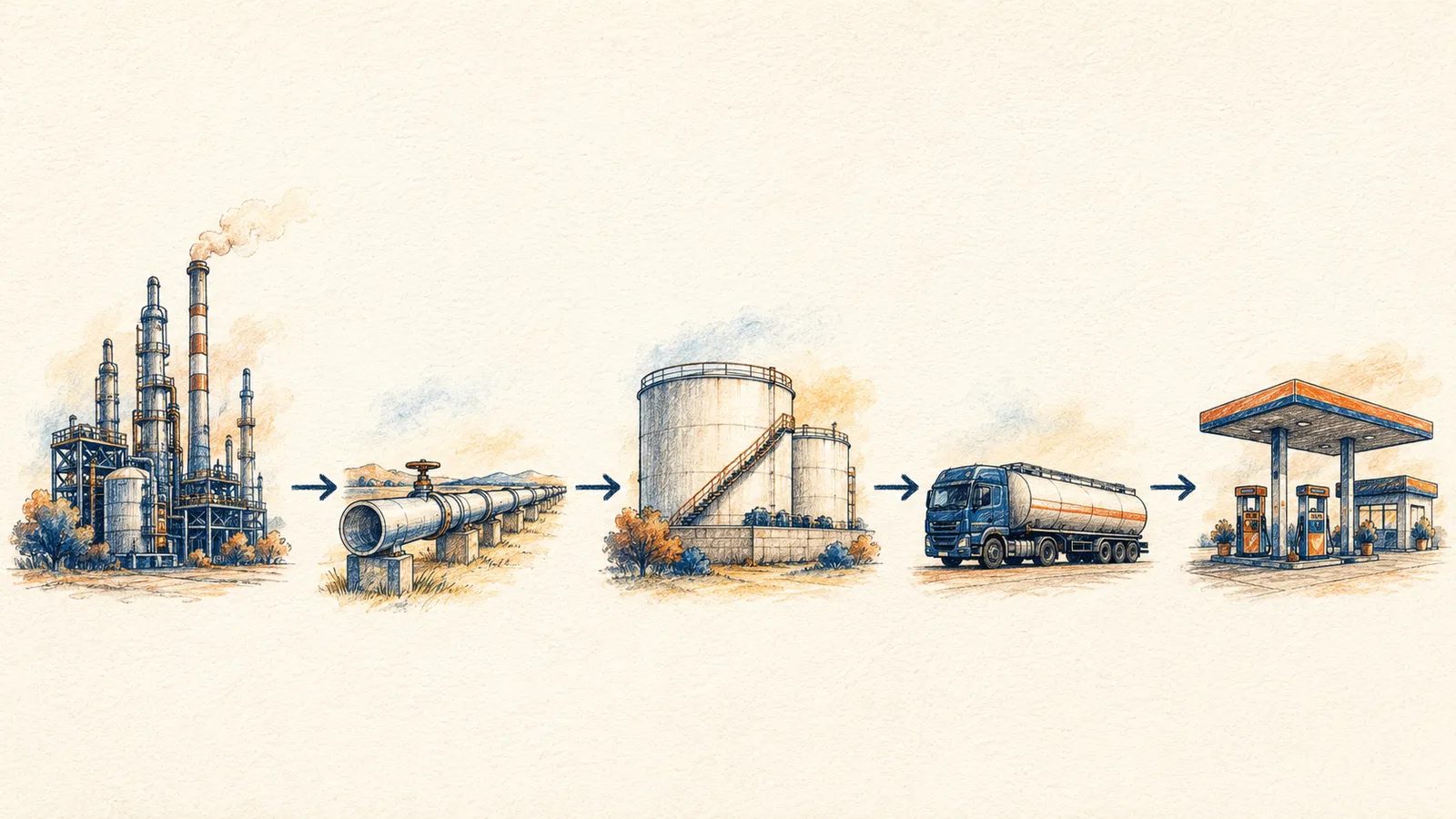
Ask most people what the fuel business looks like and they will describe a gas station. A bright canopy, a familiar brand, a price on a tall sign by the road. That forecourt is real, and it is the part of the industry built to be seen. It is also the small end of it. Most of the fuel sold in this country never passes through a pump the public would recognize. It moves through the wholesale channel, between companies, on contracts, long before any of it reaches a nozzle. More than eighty percent of US fuel volume sells that way. The station is the showroom. The wholesale side is the business.
Retail is the part you can see
The retail channel is fuel sold straight to the person who burns it, at a service station, under a brand. It is the public face of the whole industry, and it behaves like a public face. The sign price gets compared to the station across the street, margins are thin, and a couple of cents moves traffic from one corner to another. It is a real business and a hard one, and pricing the pump is its own craft. But for all the attention it draws, retail is the visible tip of a much larger trade.
Wholesale is where the volume is
The wholesale channel moves fuel in bulk between businesses, often on agreements that run for years. The public never sees it, because there is nothing to see. No canopy, no sign, no advertising. Just product moving on contracts from refiners and terminals out to the companies that deliver it to the end of the line. Strip away the brand campaigns and the corner price wars and the heart of petroleum marketing is the steady execution of long-term supply contracts with large, sophisticated buyers. That is where the bulk of the gallons go, and it is where the real money changes hands.
The two ways fuel sells wholesale
Inside the wholesale channel there are two kinds of buyer, and they behave nothing alike.
End users are the companies that buy fuel to consume it. Airlines, utilities, railroads, chemical plants, mines, large municipal and trucking fleets. They take delivery in big quantities straight into their own tanks, sometimes hundreds of thousands of gallons at a time, and they never resell a drop. For them fuel is an input, and the buying decision is about supply security and price, handled by people who do it for a living.
Resellers are the middlemen, the jobbers and distributors. They buy refined product and sell it on without changing what it is. A branded reseller carries one refiner's product and flies its flag. An unbranded reseller buys wherever the price is right and sells under its own name. Either way, the reseller is the company that takes a truckload off the terminal and turns it into a hundred deliveries to dealers, stations, farms, and fleets across a region.
The jobber sits in the middle on purpose
The reseller exists because the refiner does not want to bill and deliver to ten thousand small accounts, and the small accounts could never buy at terminal scale. The jobber bridges that gap. It buys at the rack in bulk, breaks the volume into truckloads, runs the routes, carries the credit, and knows the territory house by house. That is the whole reason the channel has a middle. How a jobber actually earns comes from doing that work well, and operators who own stations through a commissioned agent add another layer on top of it.
It runs on relationships and credit, not advertising
The thing to understand about the wholesale side is how little it has to do with the brand ads the public sees. It runs on terms, allocation, and trust. A refiner hands its best price and its steadiest supply to the buyers who pay on time and move real volume, and a jobber extends that same kind of credit down to its own customers, financing the gap between a supplier who wants paying in ten days and a customer who wants thirty. Watching that credit is a core job, not an afterthought. And when supply gets tight, the allocation goes to the relationships that were built in the calm. None of that shows up on a billboard. It is settled in offices and over years, which is exactly why it stays invisible to the public.
What it means for how you run
If you work the wholesale side, the lesson is plain. Your business lives on the machinery nobody photographs: contracts honored, loads billed to the gallon with the right taxes, credit watched before an account slips, allocation managed when product is short. The retail price war gets the headlines. The wholesale back office keeps the score, and it is unforgiving about detail because the margins are thin and the volumes are large. Software made for this trade is built for that reality first, the contracts and the bills of lading and the fuel tax, rather than the cash register the public pictures. Run that part tight and the visible end takes care of itself.
Shopping for the system that runs this side? Start with best petroleum wholesale software.