
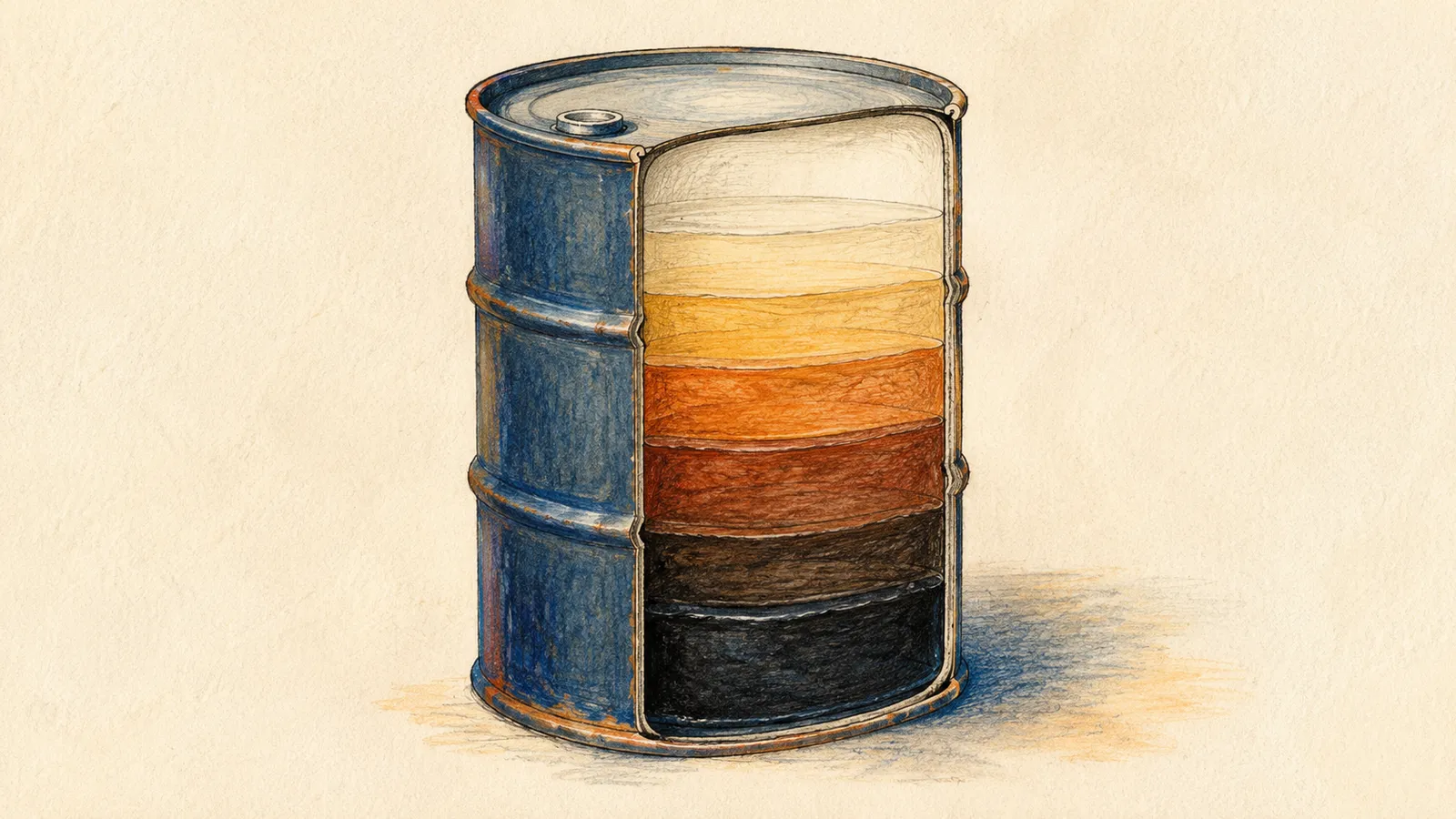
A refiner and a fuel marketer look at the same barrel of oil and see two different things. The refiner sees how it boils apart, the cuts that come off the still from lightest to heaviest. The marketer sees a list of products that each have to find a buyer. Same forty-two gallons, two ways of reading it, and the space between those two views is where a marketer earns a living. People in the trade have names for the two views. The refiner thinks in the production barrel. The marketer thinks in the demand barrel.
Two ways to read the same barrel
The production barrel is the chemistry. Crude goes into a still and separates by boiling point. The light ends come off first, things like propane and the blendstock that becomes gasoline. The middle cut is distillate, which becomes diesel and heating oil. Heavier still are the residual fuels, and at the bottom sit asphalt and coke. A refiner can shift that mix within limits by cracking heavier molecules into lighter ones, but the barrel still yields a slate, not a single product of your choosing.
The demand barrel is who buys what. Gasoline goes in cars. Diesel goes in trucks, tractors, and generators. Jet fuel flies. Heating oil warms a house in February. Propane cooks and dries grain. Asphalt paves a road. Each of those customers shows up at a different time, in a different place, and will pay a different margin. The marketer's job is to line the demand barrel up against the production barrel and clear the whole thing.
The whole barrel has to go somewhere
This is the part that surprises people new to the business. You do not get to sell only the cut with the best margin. When a refinery runs crude, it makes the entire slate at once, so every gallon of gasoline comes with its share of distillate, jet, residual fuel, and the heavy bottoms. If nobody buys the heavy end, it backs up and the whole plant has to slow down. So a working fuel market is really a constant effort to find a home for all of it, the unglamorous cuts included, at whatever price clears them that week.
That is why a jobber's product list runs well past the pump. Beyond gasoline and on-road diesel, the same supply chain carries heating oil, dyed off-road diesel, propane, kerosene, lubricants, and diesel exhaust fluid. Some of those are true barrel cuts and some ride alongside as related products, but the operator who handles more of the slate has more ways to keep trucks full and margins steady when one product goes soft.
Diesel and heating oil are the same cut wearing different hats
Here is a fact that explains a lot of winter drama in this business. On-road diesel and home heating oil both come from the middle distillate cut. Chemically they are close cousins, separated mostly by sulfur rules, taxes, and a dye. So when a hard cold snap drives heating-oil demand up the East Coast, it pulls on the very same pool of distillate that long-haul trucking needs, and the price of diesel feels it. A marketer who understands that does not treat the heating season and the freight season as separate worlds. They are drawing from one tank.
Demand moves with the season and the map; the barrel does not
The production barrel is fairly steady. Demand is anything but. Gasoline peaks in the summer driving months, and the fuel itself even changes with the calendar, since summer and winter gasoline are blended differently for evaporation rules. Distillate peaks in the cold. Geography pulls in its own directions too. The United States runs gasoline-heavy because the country drives, while much of Europe leans toward diesel because of how their fuel is taxed. The barrel coming out of the still does not care about any of that. Matching a steady supply slate against demand that swings by month and by region is the daily puzzle of fuel marketing.
What this means if you sell fuel for a living
The practical lesson is that your product slate is half decided before you sell a single gallon. The barrel hands you a range of products, and the smart move is to build a customer base that can absorb more than one of them. The operator who sells gasoline and on-road diesel in the summer and pivots the same trucks to heating oil in the winter is reading the demand barrel correctly. So is the one who adds propane for the farms and lubricants for the fleets, smoothing out the months when motor fuel margin is thin. You are not really in the gasoline business. You are in the business of clearing a slate of products into a region, season by season, at a margin you can live with.
It also reframes price. The pump number the public watches is the tail end of a long chain that starts with what goes into a gallon and runs through the cost of every other cut in the barrel. When the heavy end is weak or the distillate market is tight, it shows up in what you pay and what you can charge, even on products that look unrelated.
Why the demand barrel lands in your back office
Reading the barrel well is a market skill. Acting on it is an operations one, and that is where it gets concrete. Each product on your slate carries its own tax treatment, its own unit and season, and its own kind of customer. Gasoline and on-road diesel carry road tax. Dyed diesel and heating oil do not, and mixing those rules up is how a clean operation gets an ugly audit. Propane is sold by the gallon off a different truck and a different tank. The fleets buying diesel want net-thirty terms; the homeowner buying heating oil wants a budget plan. A back office built for fuel keeps all of that straight, prices each product off its real cost, and shows you the margin on every line so you can see which part of the barrel is actually paying you this month. That is the difference between selling the whole barrel and just hoping it clears.